
The world is a better place because of the people who have made it so. A portion of these people are social entrepreneurs; men and women using the principles of business to run organizations whose goal is improving the quality of life. Social entrepreneurs understand that the world is a network of complicated systems interacting with each other to give the results that many accept as reality. For many, the need to improve this reality is what inspires what they do, so they study, analyze and integrate themselves into the system to begin to influence it.
The process of influencing systems is often riddled with bureaucracy, cultural resistance, and outright antagonism. Sometimes they start to see results, real life validation that the work they do is veritably changing an element of the system. Naturally following this is the desire to scale operations; geographically for example, so that more people can benefit from the solution, thus increasing its impact. However, in some cases that will never be enough. And while their organizations might be thriving by strict business definitions, the frustration that comes with this realization always leaves more to be desired.
Confronting the complicated and often resistant systems that stand in the way of social impact is difficult enough, but some social entrepreneurs are taking an even more subversive approach: seeking to change the system itself. Rather than brainstorming solutions that are scalable organizationally, these social change agents look at how their solutions can be structured to achieve systemic scale. It begins with a reorientation so fundamental that it sometimes requires a reworking of the business model itself or establishment of a whole new organization to address the problem.
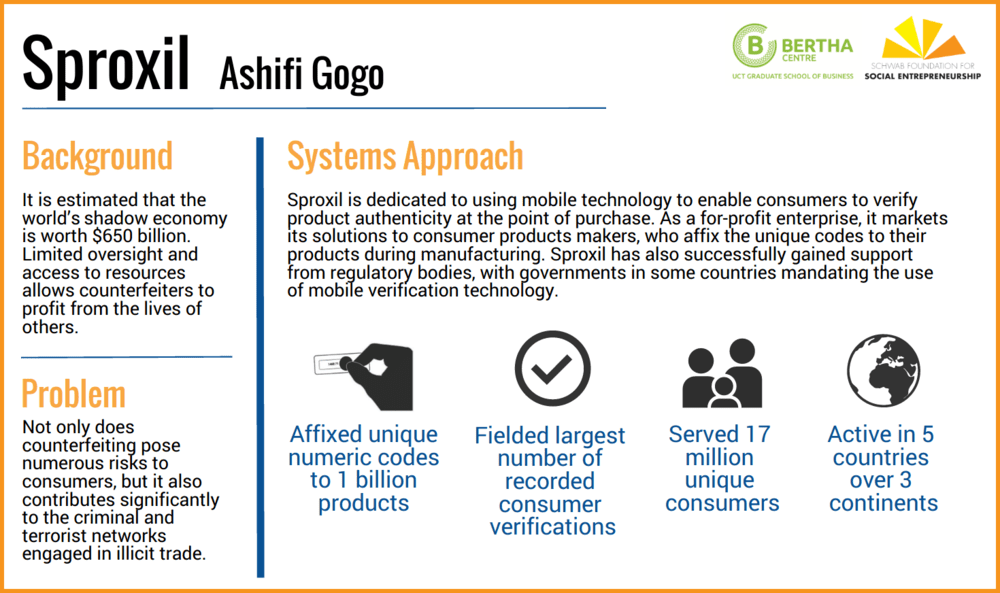
In 2010 when Sproxil introduced its anti-counterfeiting solution to Nigeria, a pilot was run with Biofem, a leading pharmaceutical distributor. The results were so good that the Nigerian government didn’t only endorse the solution but implemented legislation that compelled manufacturers or distributors of certain pharmaceutical products to adopt the technology.
If these results were scaled to cover the rest of the world, for instance, the pharmaceutical industry would be secure. However, even a cursory look at the number of products which can lead to fatal outcomes if their counterfeits are ingested still show millions of consumer products largely uncovered, not to mention the economic loss to brands.
Even if all governments were as centralized and thus powerful as the Nigerian government, they could not compel every manufacturer to adopt consumer protection solutions. A new product needed to be created with which Sproxil could engage brands directly, with enough value added to incentivize them positively. With the Sproxil Champion solution, Sproxil can engage manufacturers of other consumer products on a much wider scale and influence the system to ensure a lot of brands can provide authentic products to their customers. This is one among many examples of systems thinking detailed in the Schwab report.
As more social entrepreneurs converge around the idea of ‘systems change’ the Schwab Foundation for Social Entrepreneurship, in collaboration with the Bertha Centre for Social Innovation & Entrepreneurship, UCT Graduate School of Business, has put together ‘Social Entrepreneurship and Systems Entrepreneurship: From Organizational to Systemic Scale’ an insight report launched on the 2nd of May, to help social entrepreneurs understand systems change thinking.
Alongside Sproxil, five other social entrepreneurship from various continents were researched, and their case studies, as well as core lessons from their examples, are included in the report, which will be very helpful reference material for social entrepreneurs.
Sproxil is honored to have been among the six social enterprises that were the subject of this study. We would like to thank the Schwab Foundation, the Bertha Centre for Social Innovation & Entrepreneurship, and every person who put in the time or lent their expertise to this project. We hope this report inspires you to be systemic in your thinking so that we can generate even more innovative ideas for changing the world on a broader scale.

 Blog
Blog 