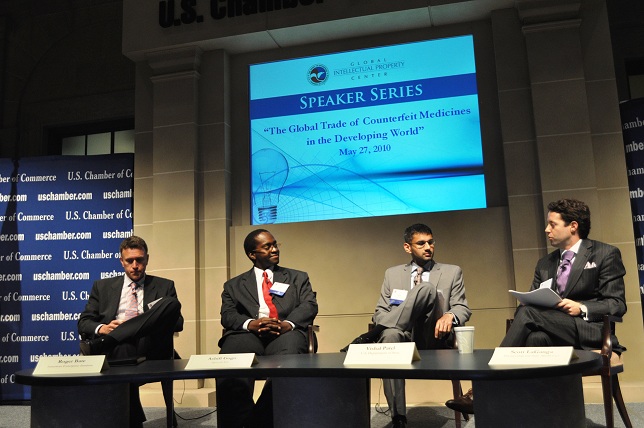
Sproxil’s CEO Panelist on GIPC Speaker Series: “The Global Trade of Counterfeit Medicines in the Developing World”


The Global Intellectual Property Center at the US Chamber of Commerce is hosting Dr. Roger Bate, a fellow at the American Enterprise Institute and a leading researcher on the challenges of counterfeit medication in health systems. We are excited to hear about his latest research on fake drugs in India, and looking forward to contributing to key discussions that move the anti-counterfeiting field forward as we join him on the post-talk panel.

If you’re in DC this week and you’re interested in the $75 billion fake drug problem, attending this event would be great use of your time. Register here.

Update: See the related blog post here

Sproxil’s CFO & Strategist to Present at Health Informatics Forum: Innovative Tools for Informed Decisions


We are glad to announce that Sproxil will be presenting at the Health Informatics Forum, organized by the Futures Group. We are glad to be collaborating with the Futures Group to highlight tools that leverage available equipment and local knowledge in developing nations to solve rather large problems.

More on the forum:

Health informatics synthesizes relevant information technology tools with an understanding of health information and how it can be used to support better decisions and better health outcomes. The Health Informatics Forum will provide a hands-on opportunity to exchange ideas on informatics applications used in settings with low technical capacities and discuss how these tools inform decisionmakers at every level, from community health workers to policymakers.

See you in DC on June 3.

A Round of Updates


We’ve been very busy at Sproxil lately. NAFDAC’s Mobile Anti-Counterfeiting Service (MAS) keeps growing in popularity. With the addition of Etisalat, a popular mobile network in Nigeria, consumers can now text on any GSM network in the country using the same “911 for fake drugs” number: 38353. We’ve already seen uptake on the Etisalat network – we’re glad to be of value to end consumers. Nigerians can still text through MTN, Glo and Zain as they have been doing over the past several weeks.

For those who have been wondering what kind of reach we have working with some of the largest GSM networks in West Africa, take a look at the data provided by the Nigerian Communications Commission (NCC). As of February 2010, we could reach out to over 67 million users. With Nigeria leading Africa in mobile telephone adoption (4.1 million new users in Q4 2009), we are confident our user base will keep growing strongly.

On the pharmaceutical side, Pharmaceutical Commerce just published an article on Sproxil: Sproxil Inc. offers proof of concept for patient communication in drug authentication.

Vanguard: NAFDAC intercepts fake drugs worth N600m (USD 4m)

NAFDAC has just disclosed that it has located USD 4m in fake drugs destined for Nigeria. This is a big win for Nigeria. The seven trucks loaded with fake medication have been prevented from entering the Nigerian market. In addition to the use of technology to find counterfeits, NAFDAC is also using best practices from the security/intelligence community, as revealed in the Vanguard article. We can also attest to this based on our interactions with NAFDAC.

We keep stressing that technology is an efficiency multiplier. An organization that doesn’t have skilled staff, strong leadership and a focused mission may not gain maximal value from the use of technology. It’s great to see that NAFDAC is proving this point by adopting existing strategies in the intelligence community while enhancing its anti-counterfeiting practices with a portfolio of technologies deployed at different levels in the supply chain. The results are clear.

Updated counterfeiting information from the UK Parliamentary Office of Science and Technology (POST)

This is a really short post. Given how it’s often challenging to get good information on counterfeiting, we would like to help share recent information from the UK POST. Take a look at their report and listen to their 15 min podcast. You may even subscribe to their feed so that you get the latest information right away (includes much more than counterfeiting information).
Enjoy.

Chinese Consul-General reportedly blames Nigerian businessmen for fakes

allAfrica.com is reporting that the Chinese Consul-General in Lagos, Mr. Guo Kun, said Nigerian entrepreneurs are making Chinese companies produce sub-standard goods and that the Chinese companies do so because they want the business.
They say that during an official visit by a Chinese People’s Association for Friendship with Foreign Countries (CPAFFC) delegation to strengthen bilateral relationships he said “It is a real problem for a product that is say 10 dollars (about N1500) of standard quality, some of the [Nigerian] entrepreneurs went to China, and asked the host to make it thinner and cheaper. At the very beginning, some of the [Chinese] companies were very reluctant to produce for them. But later, you know they are entrepreneurs, they want to make money. These host factories don’t want to make for them, to produce for them. Finally they [Nigerian entrepreneurs] went to many factories, at least they can find one or two factories to make for them sub-standard goods and they bring it back,” to Nigeria.

This raises the age old question of who is responsible for sub-standard products, is it the illegitimate manufacturer, the importer or both? You can read the original article here.

GH/Innovate welcomes technology and entrepreneurship as catalysts for change in Global Health

The recent GH/Innovate 2010 conference at Yale University featured 200 speakers, including Seth Godin and Jeffrey Sachs. CNN calls it “a meeting of minds.” Participants at this year’s conference seemed eager to learn about new models in financing, novel applications of technology and good impact monitoring in global health. With 2,200 attendees from over 55 countries, the conference had diverse sessions and workshops that provided original views on successful healthcare-related entrepreneurial strategies deployed around the world.

Sproxil’s CEO was invited to lead a 90-minute workshop on the role of technology and entrepreneurship in global health. The workshop plus the subsequent panel presentation were captured by the Global Health Ideas blog.

We’re glad to provide guidance to promising entrepreneurs who want to take on some of the world’s largest problems.

Sproxil CEO featured in exclusive interview on The World’s Technology Podcast

Clark Boyd, of The World‘s Technology Podcast, recently interviewed Sproxil CEO and co-founder Ashifi Gogo about his new counterfeit-fighting technology. Gogo describes the basic premise of Sproxil, which basically combines scratch-off labels and SMS technology on cell phones to validate medicines sold in the developing world. Gogo stated that the technology was originally intended to be used on the organic industry, but by the time his method was ready for introduction, organics were already an established market. So the company went in another direction, re-tooling the technology so that it could be used to fight counterfeit medicines instead, which pose a $75B problem around the globe. Sproxil is currently trialing the technology in Nigeria, where up to 33% of medicines sold are fake. Gogo explains that there are checks done at ports and borders in West Africa, but there is no “crowdsourced” approach to identify substandard medicines.
As many readers already know, Sproxil works with legitimate manufacturers by providing them with one-time use scratch off labels (like lottery tickets), which are applied to product packaging at the source of manufacture or location of importation. The customer then scratches the label to reveal a hidden item-unique code, and sends the item code via text message (paid for by the product manufacturer) to the Sproxil database, ti which Sproxil immediately replies with an authenticating “yes” or “no”.

Launching the service in Nigeria has gained the interest of many big-name manufacturers. Present funding has come from grants such as the Clinton Initiative, Nokia, as well as several business and social enterprise organizations that reward good ideas. Right now, there are one million sachets out on a diabetes medication across the country of Nigeria, and according to pharmacies, customers are beginning to purchase only the packages with the Sproxil label. Piloting the product on this medication, which diabetics rely on daily, is particularly appropriate.

Gogo also discusses the probability of Sproxil’s future involvement in other markets struggling with counterfeiting, such as the textiles and education markets, and he asserts that there is “a very general need for authentication in West Africa,” and according to a number of other articles, around the world. Sproxil also plans to reach the software market through creative entertainment like the music and movie industries.

Sproxil is the only testable initiative for consumer-based, anti-counterfeit technology right now, partly because  of its for-profit approach. There are four potential revenue streams that have been identified:

1) Authentication, where companies pay to protect their brand

2) Advisory, or supply-chain consulting

3) Analytics, or data-mining

4) Advertising

Sproxil is already receiving some revenue for its authentication and advisory services. It has not yet expanded to include analytics and advertising in its offerings. Click here listen to this exclusive interview on The World‘s Tech Podcast.

The Brazilian Serialization Initiative

Brazil, home of 191M people and the largest drug market in South America (estimated at $17B in 2008), has just implemented a three-year plan to track all of its medicinal prescription products, both human and veterinary, using a 2D datamatrix barcode. The goal is to put in place a thorough method through which all pharmaceutical products can be traced from producer to end-user using safety codes located on the packaging. These so-called Medicine Single Identifier labels will contain unique barcodes that link the medicine to its registration number, lot number, production date, etc. in an official database. Medicine manufacturing companies will be responsible for ensuring that all of their products contain these safety labels, which companies can buy either blank or with codes already printed on them. The national regulatory agency – ANVISA – will supply all pharmacies with scanners in order to verify the authenticity of products at or before the time of purchase.
Several of the issues raised by these new rules include questions about the regulation of international medicines: can pharma products produced outside the country use the codes provided by Brazilian national authorities? If so, and assuming that ANVISA will require all serialization codes to be applied within the country/upon product entry into the Brazilian drug market, it seems that international medicines will be significantly less secure despite their secure assurance label. We reckon consumers might also wonder about the system’s transparency – if pharmacists are now selling fakes and they will also be doing the checking using special scanners, consumers seem to be left out in the dark in this new process and it may not be as effective as a solution that puts the power of authentication in the hands of the consumer.

Questions have also been raised about whether the national database will be government- or commercially-maintained. Interestingly, Sproxil avoids uncertainty on all of these concerns:

  1. we sell scratch-off codes to pharmaceutical manufacturing companies whose products appear in Nigerian markets, regardless of their production location
  2. we put the power of authentication in the hands of the consumer
  3. we keep a private, encrypted information database in a redundant cloud

In any case, it would seem that even though Brazil is on its way to decreasing the 25% market share that counterfeits currently hold, the country has a bit further to go before its 1 January 2012 timetable deadline. Other countries, such as the USA, have tried to set deadlines on serialization projects to spur industry adoption, but that approach doesn’t seem to be effective. We hope to see much more industry collaboration with the authorities in Brazil to make the project successful.